



Textbooks divide monkeys neatly. Some South and Central American monkeys have prehensile tails that work as a fifth limb. The monkeys of Africa and Asia, the cercopithecids, do not: their tails are for balance, and are classed as non-prehensile.
This project looked closely at how wild cercopithecids really use their tails, and found that the line is not so clean. In video from Kibale National Park in Uganda, monkeys of six species wrapped their tails partly or fully around a branch or another animal. We described this as semi-prehensile tail use: the first time the behaviour has been documented in detail in wild cercopithecid monkeys.
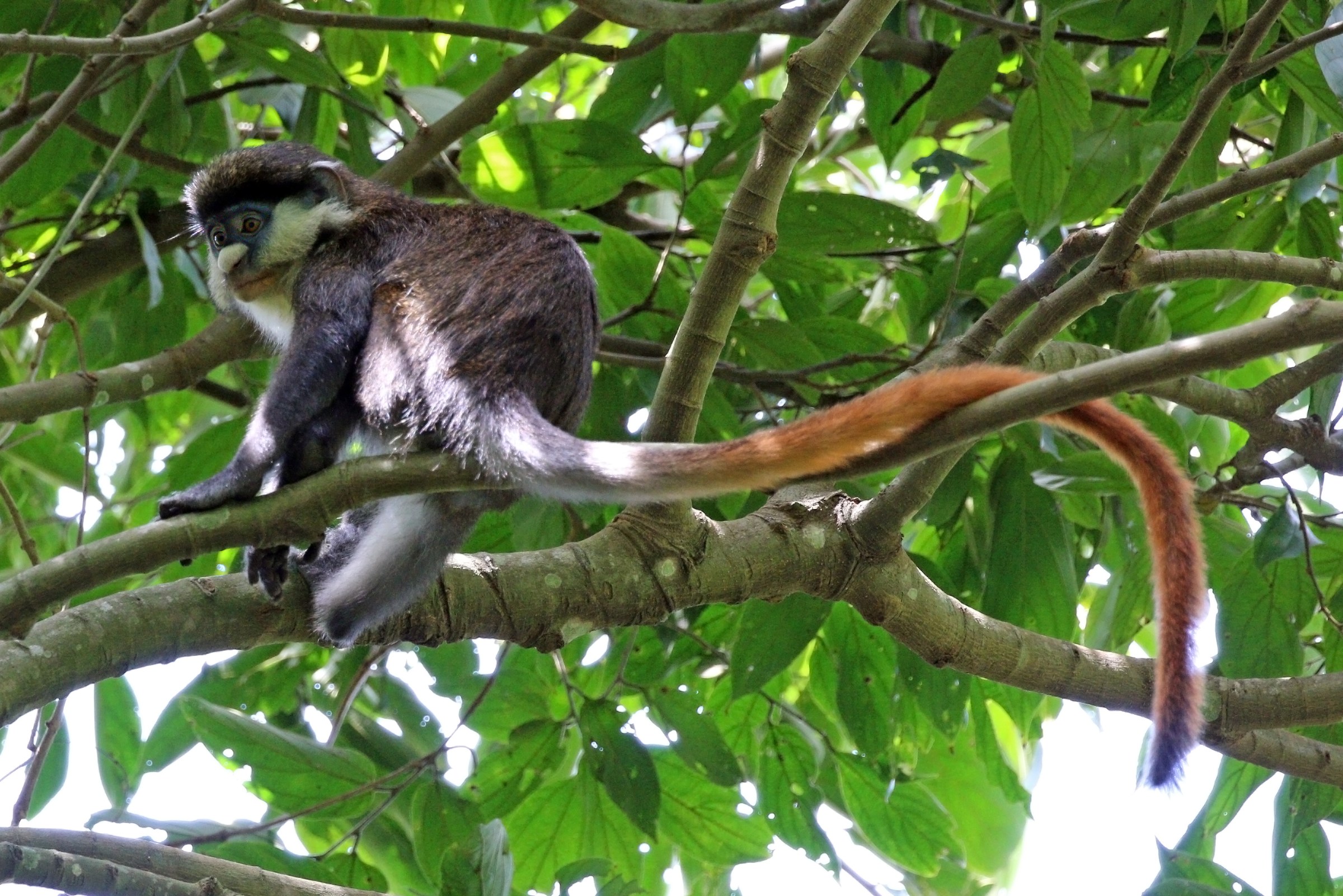
,_Semliki_Wildlife_Reserve.jpg)
My part
I worked on the behavioural analysis. The raw material was a large set of field recordings of monkeys moving through the forest, and my job was to process and annotate that footage: going through the videos, identifying behaviours and interactions, and recording when and how each animal used its tail.
What the footage showed
- Adults of six species used their tails this way: olive baboons (Papio anubis), blue monkeys (Cercopithecus mitis), red-tailed monkeys (C. ascanius), guereza colobus (Colobus guereza), grey-cheeked mangabeys (Lophocebus albigena) and vervet monkeys (Chlorocebus aethiops). It mostly happened while they were foraging for leaves or tree gum, or holding an unstable posture supported by three limbs or fewer.
- Juvenile baboons used the tail to steady themselves while moving along precarious branches.
- Infants of three species wrapped their tails around their mother’s tail or hind leg while clinging to her belly.
Why it matters
If monkeys without a true prehensile tail still grip with it when balance is at stake, that helps explain how full prehensility could have evolved in the American monkeys, and shows more of what a tail does for an animal living in the trees.
Publication
Myers, Lydia C., Judith Janisch, Nicole M. Schapker, Anthony Cundari, Asas Husain, Alex Silva, Jesse W. Young, and Liza J. Shapiro. 2024. “Semi-Prehensile Tail Use in Wild Cercopithecid Monkeys.” Annual meeting of the American Association of Biological Anthropologists. American Journal of Biological Anthropology 183 (S77): 123. https://doi.org/10.1002/ajpa.24928.
The work was supported by the National Science Foundation (BCS-1921135 and BCS-1921314).